COLD STORAGES · OPERATIONS · QA
Cold Storage Temperature Requirements in India: What FSSAI, CDSCO, and Your Buyer Actually Expect (2026)
Three regulators. Three sets of numbers. One question your buyer is going to ask anyway.
Every cold storage operator in India answers to at least two authorities. Food operators answer to FSSAI. Pharma operators answer to CDSCO. And every operator — food or pharma — answers to the buyer sitting across the table, asking for the temperature record.
The numbers are not hard to find. What is hard is keeping track of which number applies to which product, which regulator checks it, and what "proof" actually means in 2026 — because all three now expect something different from what they expected two years ago.
This is the reference guide. Real numbers. Real penalties. Real cases. No filler.
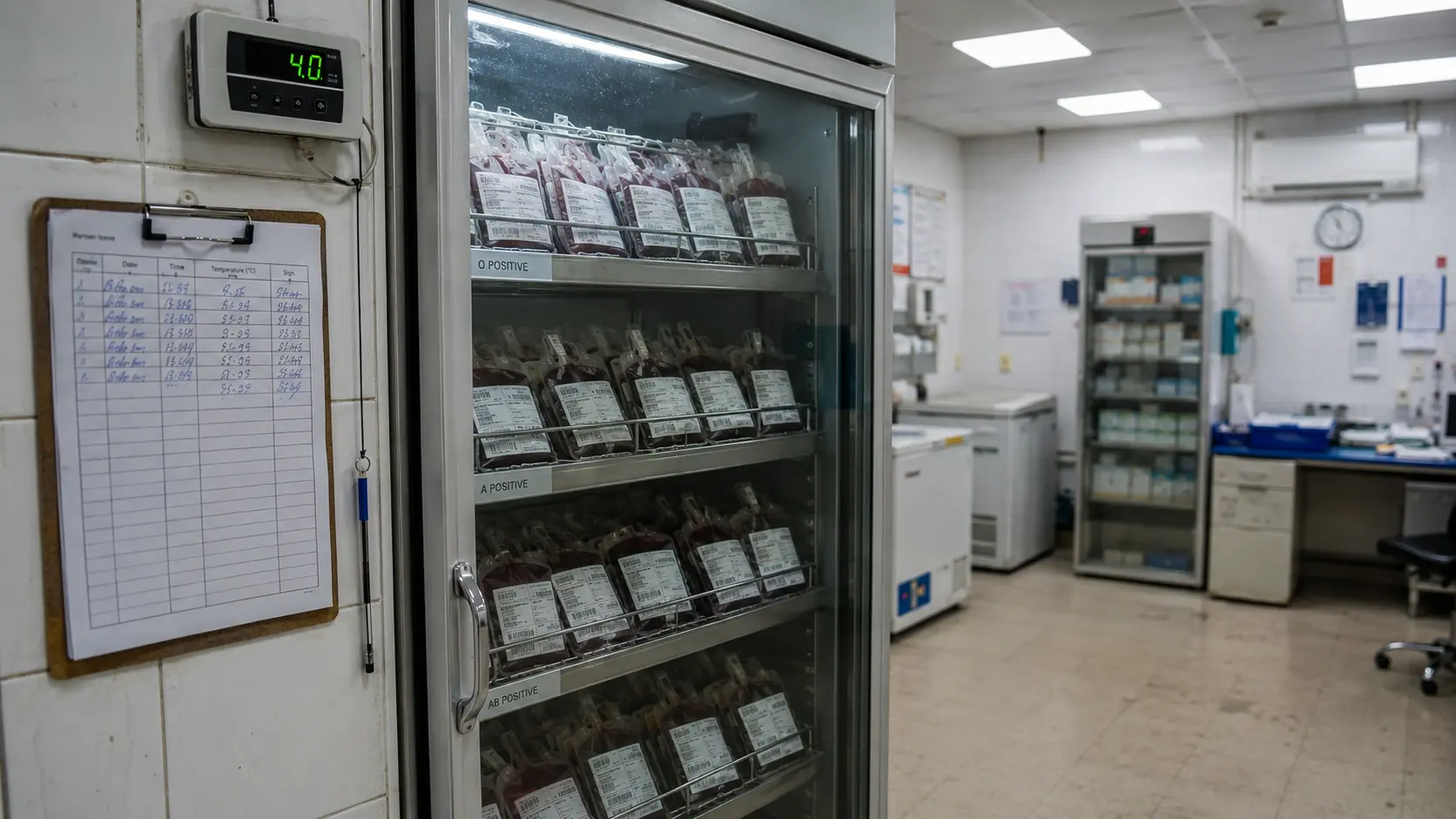
If you also operate hospital, blood bank, or diagnostic lab storage, the companion guide — What Temperature Should It Be? Real Numbers for Hospitals, Blood Banks, and Labs — covers those facilities separately.
FSSAI temperature requirements for food cold storage
FSSAI governs every food cold storage facility in India — frozen, chilled, dairy, meat, seafood, fruits, vegetables, and ready-to-eat. An FSSAI license for cold storage is mandatory, classified by annual turnover under the FoSCoS matrix updated April 1, 2026. Here are the numbers by product type.
Frozen storage temperature
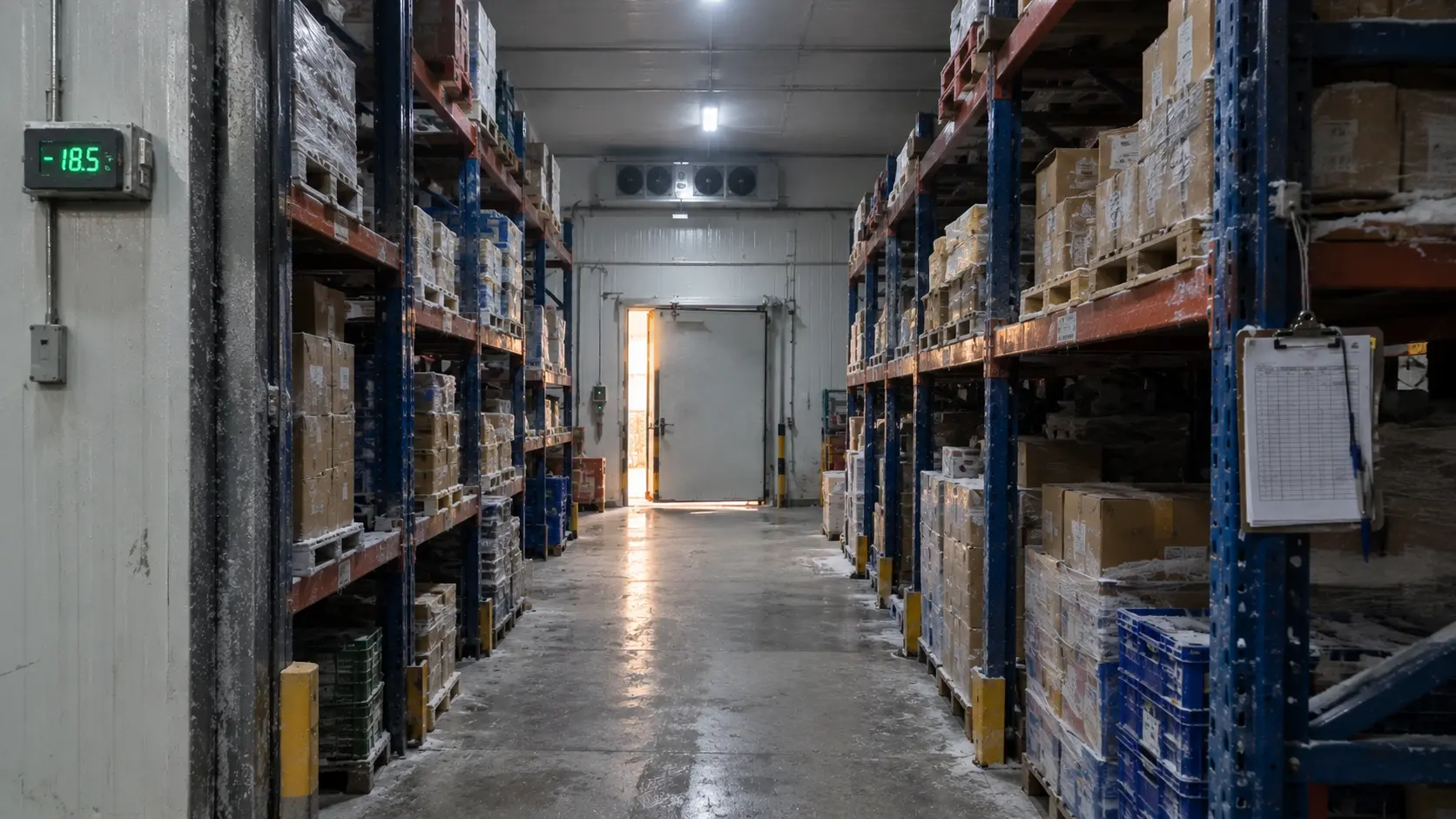
-18°C or below. This is the baseline cold room temperature range for all frozen food — FSSAI, Codex Alimentarius, and FDA all agree on this number. In practice, most Indian cold storages operate between -23°C and -18°C to buffer against door openings, defrost cycles, and product loading. Walk-in freezer temperature should hold -18°C or colder at all times, with the operating setpoint typically at -20°C to -23°C.
Blast freezer temperature
-35°C to -40°C. Blast freezers use high-velocity cold air to rapidly bring product core temperature down to -18°C or below. Seafood blocks typically take 1–2 hours. IQF (individually quick frozen) systems freeze each piece in 3–20 minutes. The blast freezer temperature itself is not a storage standard — it is a processing standard that applies during the freezing cycle.
Chilled storage temperature
0°C to 5°C. Applies to fresh produce, chilled seafood, short-shelf-life products, and products in transit between processing and frozen storage. The cold room temperature range for chilled storage is narrower than frozen — a 1–2°C drift above 5°C triggers investigation under FSSAI guidance.
Meat storage temperature
Chilled meat: 0°C to 4°C. FSSAI mandates HACCP-based monitoring at every critical control point from slaughter to retail. Frozen meat: -18°C or below. The February 2026 FSSAI amendments introduced additional requirements for segregation and traceability of meat products.
Dairy storage temperature
2°C to 4°C for refrigerated dairy products. Frozen dairy follows the -18°C baseline. Dairy products are among the most temperature-sensitive food categories — a brief excursion above 4°C can trigger microbial growth that is invisible at the point of storage but shows up at the point of consumption.
Controlled room temperature (food)
15°C to 25°C. For dry goods, grains, spices, and shelf-stable products that still need temperature control to prevent degradation. Not "ambient" — controlled, documented, and logged.
What FSSAI actually checks (not just the number)
FSSAI does not just ask whether your cold storage is at the right temperature today. It asks for documented temperature logs — and the revised enforcement posture is real. On August 22, 2026, FSSAI announced enforcement action involving 150 notices to food companies, product seizures, and license suspensions across multiple sectors. The penalty for substandard storage can reach ₹5 lakh, with license suspension or cancellation for repeated violations. The gap between "the compressor works" and "here is the documented log" is where most citations land.
CDSCO and Schedule M requirements for pharma cold storage
If your cold storage handles pharmaceutical products — vaccines, biologics, APIs, finished dosage — you answer to CDSCO under the Drugs and Cosmetics Rules. The revised Schedule M (notified December 2023, effective January 1, 2026 for all manufacturers including MSMEs) changed the bar significantly.
Pharma refrigerated storage temperature
2°C to 8°C. Vaccines, biologics, insulin, most injectables. This is the most common pharma cold storage range and the one CDSCO inspectors check first.
Controlled room temperature (pharma)
15°C to 25°C (with excursions permitted between 2°C and 30°C under specific conditions). APIs, finished dosage forms, most oral solids.
Frozen pharma storage temperature
-15°C to -25°C. Certain biologics, reference standards, and temperature-sensitive intermediates.
Ultra-cold pharma storage temperature
-60°C to -80°C. mRNA vaccines, advanced cell therapies, specialty biologics. Requires redundant backup systems — backup freezer, LN₂, or CO₂.
What Schedule M now requires (effective January 2026)
- IQ/OQ/PQ is mandatory for all cold storage equipment used in pharma manufacturing and distribution. Installing a cooling unit and turning it on is no longer sufficient.
- Real-time temperature monitoring with automated deviation logging is required. Manual temperature records are explicitly no longer sufficient under the revised standard.
- Calibration and validation of all temperature-control equipment must be documented and traceable.
- Mapping, monitoring records, calibrated equipment, segregation, and traceability are all expected — not recommended.
For biological products specifically, CDSCO's GDP guidance requires alarm systems for deviations, backup power or alternate storage, and written procedures to investigate every temperature excursion.
The Schedule M deadline is not a future event
Revised Schedule M became effective for manufacturers with turnover above ₹250 crore from June 29, 2024, and for all remaining manufacturers (including MSMEs) from January 1, 2026. If your pharma cold storage is still running on manual logs and periodic checks, you are already past the compliance deadline. CDSCO state drug controllers are the enforcing authority, and inspections against the revised standard are underway.
What your buyer actually expects — and why it is now the hardest bar
FSSAI and CDSCO set the regulatory floor. Your buyer sets the operational ceiling. And in 2026, the buyer's bar is often higher than the regulator's.
Export buyers (EU, US, Middle East, Japan) now routinely require GDP-compliant temperature records covering the full storage and cold chain. A verbal assurance that the cold storage "maintained temperature" is no longer accepted. They want the data — continuous, timestamped, retrievable.
Modern trade retailers (D-Mart, Reliance Retail, BigBasket, Flipkart Grocery, Amazon Fresh) are increasingly requiring suppliers to provide continuous temperature proof as a condition of listing. A cold storage that cannot produce a 30-day temperature log on demand is a supply chain risk the retailer does not want to carry.
QSR chains and food service companies require documented cold chain compliance from every link in their supply chain — including third-party cold storages. Their audit teams check what FSSAI inspectors check, plus their own internal standards (which are often stricter).
The pattern: the buyer does not wait for FSSAI to cite you. The buyer does their own check. And the check is always the same question — can you produce the temperature record, right now, for the dates I am asking about?
India's cold storage reality — why the gap matters
India loses roughly 40% of its perishable food production to supply chain gaps, including cold storage failures. The cold chain infrastructure is growing fast — but the monitoring and documentation layer has not kept pace.
The typical Indian cold storage in 2026 has a working compressor, a functioning cold room, and a thermometer mounted on the wall. What it often does not have is a continuous, retrievable, tamper-evident temperature record that can be produced on demand for an auditor, a buyer, or an inspector.
That is the gap. Not temperature. Evidence.
Where Mindlabs fits
Mindlabs Anchor is a wireless temperature data logger and humidity data logger stack, running on Wi-Fi or 4G, streaming continuously to a cloud based temperature monitoring platform — with time-stamped, tamper-evident audit trails and named-user attribution built in.
For FSSAI-regulated food cold storages, that means documented temperature logs that satisfy the enforcement standard — not a paper log that someone fills in twice a day, but a continuous, retrievable record that covers every hour of every day.
For CDSCO-regulated pharma cold storages, that means Schedule M-compliant monitoring with real-time automated deviation logging, IQ/OQ/PQ-ready calibration records, and a 21 CFR Part 11-aligned audit trail that covers the full regulatory retention period.
For buyer audits, that means one answer to the one question every buyer asks: "Here is the record. It covers every day. It is tamper-evident. You can verify it right now."
Every reading feeds an IoT temperature monitoring platform with remote temperature monitoring across cold rooms, blast freezers, walk-in chillers, pharma refrigerators, and controlled-temperature warehouses — built to close the gap between "the compressor works" and "here is the proof."
Common deployment and integration questions are answered in the Mindlabs FAQ.
See how Anchor supports cold storage compliance →
Key takeaways
- Frozen food storage: -18°C or below. Walk-in freezer temperature setpoint typically -20°C to -23°C. Blast freezer temperature -35°C to -40°C during processing.
- Chilled food storage: 0–5°C. Meat chilled at 0–4°C. Dairy at 2–4°C.
- Controlled room temperature (food): 15–25°C — documented and logged, not just "ambient."
- Pharma refrigerated: 2–8°C. Controlled room 15–25°C. Frozen -15°C to -25°C. Ultra-cold -60°C to -80°C.
- Schedule M (effective January 2026): IQ/OQ/PQ mandatory. Real-time monitoring required. Manual logs no longer sufficient.
- Your buyer's bar is often higher than the regulator's. Export buyers, modern trade retailers, and QSR chains now expect continuous, retrievable temperature proof on demand.
- India's cold storage gap is not temperature — it is evidence. The compressor works. The documentation often does not.
- FSSAI enforcement is real and current: 150 notices in a single August 2026 action. Penalties up to ₹5 lakh. License suspension for repeated violations.
Frequently asked questions
What temperature should a food cold storage be in India?
FSSAI requires frozen storage at -18°C or below, chilled at 0–5°C, dairy at 2–4°C, meat chilled at 0–4°C, and controlled room at 15–25°C. The number depends on the product category.
What temperature should a pharma cold storage be in India?
CDSCO requires refrigerated pharma at 2–8°C, controlled room at 15–25°C, frozen at -15°C to -25°C, and ultra-cold at -60°C to -80°C. Schedule M revision (January 2026) mandates real-time monitoring.
What is the walk-in freezer temperature for cold storage in India?
Walk-in freezers must hold -18°C or colder per FSSAI. Operating setpoint is typically -20°C to -23°C to buffer against door openings and defrost cycles.
What is the blast freezer temperature requirement?
Blast freezers operate at -35°C to -40°C during the freezing cycle. This is a processing standard, not a storage standard. Product core temperature must reach -18°C before transfer to storage.
Is manual temperature logging still acceptable for cold storage in India?
For FSSAI food storage, manual logs are technically accepted but increasingly insufficient during enforcement. For CDSCO pharma storage, revised Schedule M explicitly requires real-time automated monitoring. Manual records are no longer sufficient.
What are the penalties for cold storage temperature violations?
FSSAI penalties reach ₹5 lakh with license suspension for repeated violations. CDSCO non-compliance with Schedule M can result in manufacturing license suspension, product recall, and prosecution.
Do export buyers require continuous temperature monitoring?
Increasingly, yes. EU, US, Middle East, and Japanese buyers require GDP-compliant temperature records as a purchase condition. Indian retailers (D-Mart, Reliance, BigBasket) are moving the same direction.
Conclusion
The temperature number was never the hard part. -18°C, 2–8°C, 0–5°C — every operator knows the number for their product. What most operators cannot produce, on the day someone asks, is the continuous, documented, tamper-evident record proving the number held.
Three regulators now expect it. Every serious buyer already demands it. The compressor was never the problem. The proof was.
Try the Sensor Drift Risk Score tool → — or talk to the Mindlabs team about putting continuous, audit-ready environmental data behind every cold room, freezer, and warehouse you operate.