The Anatomy of a Rejected Consignment
What really happens when a pharma export lands with a gap in the temperature record
For an export manager, the phone call nobody wants isn't "the shipment failed." It's "the shipment landed, but we can't release it."
That call rarely comes because the product was damaged. It usually comes because the temperature record has a gap — a customs dwell, a delayed handoff, a passive logger read too late — and under current GDP compliance requirements, an unaccounted gap is treated as a potential temperature excursion until proven otherwise.
Once that determination is made, a specific, well-documented sequence begins. It is longer, more expensive, and more procedural than most people outside the QA function realise. This article walks through that pharmaceutical export monitoring sequence step by step, so export managers, QA leads, and supply chain heads know exactly what a "rejected consignment" actually involves — and what it takes to prevent it from starting.
Industry Insight
A single cold chain failure in pharmaceutical logistics can cost anywhere from tens of thousands to several million dollars once product loss, regulatory investigation, recall logistics, and reputational damage are combined. For high-value biologics, product destruction alone can reach six figures per shipment (SenseAnywhere, 2026).
Where the sequence actually begins
The trigger is not a physical failure. It is the moment the destination team discovers an interval in the temperature record that cannot be verified.
Under EU GDP, the WHO GDP Model, 21 CFR 211.142, and equivalent requirements from CDSCO and WHO PQS, temperature-sensitive pharmaceutical shipments must arrive with a continuous, calibrated, documented record of transit conditions. Any interval where temperature is unaccounted for is treated as a potential excursion — regardless of whether the product itself was actually exposed. This is why continuous temperature monitoring across every leg of an export lane is no longer optional.
The most common ways a gap gets created in a pharma export:
- Customs dwell. A shipment held 48–72 hours during clearance can exceed the packaging's validated hold time — silently.
- Delayed put-away. Product delivered but not immediately transferred to a temperature-controlled facility accumulates exposure the moment it lands.
- Ground-handling miscommunication. A container offloaded early into a standard warehouse instead of the pharma facility. This is a well-known failure mode in cold chain monitoring.
- Passive logger limitations. A traditional temperature data logger records faithfully but can only be read at the destination. If the log shows a deviation, the discovery is retrospective.
- Logger failure or tampering. A missing, damaged, or manually stopped device produces an unverifiable gap. This is why tamper-evident, audit-trail-backed devices matter — a requirement built into 21 CFR Part 11 compliant temperature monitoring.
Whichever the cause, the next step is the same.
The seven-step temperature excursion investigation
The following sequence is drawn from established GDP and clinical trial excursion protocols (PharmaStability, PharmaGMP, PharmaEduCenter). It is not optional. It applies whenever an excursion or unverified interval is identified in the temperature record.
Step 1 — Detect and document
The receiving team downloads the temperature log. If a gap or excursion is identified, the finding is recorded formally: duration, extent, temperature range, affected products, and environmental conditions. This becomes the source document for everything that follows.
Step 2 — Quarantine the consignment
The product is immediately isolated. Further movement and distribution are stopped. The consignment stays in this state until the disposition decision is made — which, depending on complexity, can take days.
Step 3 — Notify QA and (if required) the sponsor
Quality Assurance is notified. For clinical materials, sponsor notification is mandatory and time-bound; the investigator cannot make a usability determination independently. If the product is distributed in a jurisdiction where regulatory notification is required, agencies (FDA, EMA, MHRA, CDSCO, WHO PQS) may need to be informed depending on the risk assessment.
Step 4 — Impact and stability assessment
This is where the investigation becomes expensive. QA compares excursion parameters against stability study data. Depending on the product and the excursion profile, this may include:
- Review of existing accelerated and long-term stability data
- Forced degradation studies if data gaps exist
- Additional QC testing — potency, assay, impurity profile, sterility, moisture content
- Consultation with formulation and regulatory subject-matter experts
The output is a documented impact assessment stating whether critical quality attributes (CQAs) have been affected and justifying the proposed disposition.
Step 5 — Await usability decision
The sponsor or product owner makes the final call: conditional release, further testing, or reject. The site cannot make this determination. The consignment stays in quarantine throughout.
Step 6 — Implement CAPA
A root cause investigation identifies the point of failure — equipment, human error, transport partner, documentation gap. A Corrective and Preventive Action (CAPA) plan is developed to prevent recurrence. This is inspected in future GDP audits.
Step 7 — Close the deviation
The full sequence is closed out in the Quality Management System. All records — timeline, temperature data, impact assessment, disposition, CAPA — are archived for regulatory review. During GDP inspections, temperature excursion deviations are among the most commonly reviewed items.
Real Data Insight
Excursion documentation gaps — incomplete or unreconciled cold-chain data logs — are one of the most common recurring deficiency categories in GDP inspections (Pharmasource, 2026). A gap in the record is not a footnote in an audit. It is often the finding.
The costs that stack while the sequence runs
The direct product loss is only the first line item. When a rejected or quarantined pharma consignment enters this sequence, costs compound in five distinct ways:
1. Product loss. For high-value biologics, vaccines, or specialty medicines, a single destroyed consignment can run into hundreds of thousands of dollars — or more.
2. Investigation cost. QA time, laboratory retesting, expert consultation, and documentation work. This is measured in weeks, not hours.
3. Regulatory exposure. A single GDP compliance violation can result in cargo rejection, regulatory penalties, and — for repeat findings — enforcement action against the distribution licence. Recent industry reporting indicates penalties exceeding €500,000 for serious violations (Fliteline, March 2026).
4. Downstream disruption. Hospitals waiting for the product face delays. Batches waiting on the released material shift production schedules. Insurance claims trigger commercial-relationship reviews.
5. Commercial damage. Perhaps the hardest to quantify: procurement scorecards, hospital pharmacy relationships, and freight-partner reliability records all take a hit. Repeat incidents accelerate contract termination — often before formal regulatory action.
None of this is triggered by the shipment failing to stay cold. It is triggered by the record failing to prove that it did — which is why pharmaceutical export monitoring is now a core commercial function, not a QA overhead.
The one thing that stops the sequence before it starts
The seven-step investigation is designed for a world where you find out about a problem after the consignment arrives — because that was the only time the record could be read. That world is ending.
The new bar, being enforced across FDA, EMA, MHRA, CDSCO, and WHO PQS jurisdictions, is a continuous, tamper-evident temperature record that arrives with the consignment — one that can be verified in minutes, defended against any regulator, and produced without the qualifier "we think it was fine."
Two things this changes:
-
The gap doesn't get created in the first place. Continuous in-transit temperature monitoring means the temperature record has no discovery lag. What happened is known while it is still happening.
-
Even when something does go wrong, the record can defend the consignment. A complete record showing that conditions stayed within range — even during a customs dwell — often prevents the entire seven-step sequence from being triggered.
This is the shift from passive logging to defensible evidence. It is also, quietly, the direction every major GDP regime has moved in the last two years.
Mindlabs Lite+ (USB Data Logger)
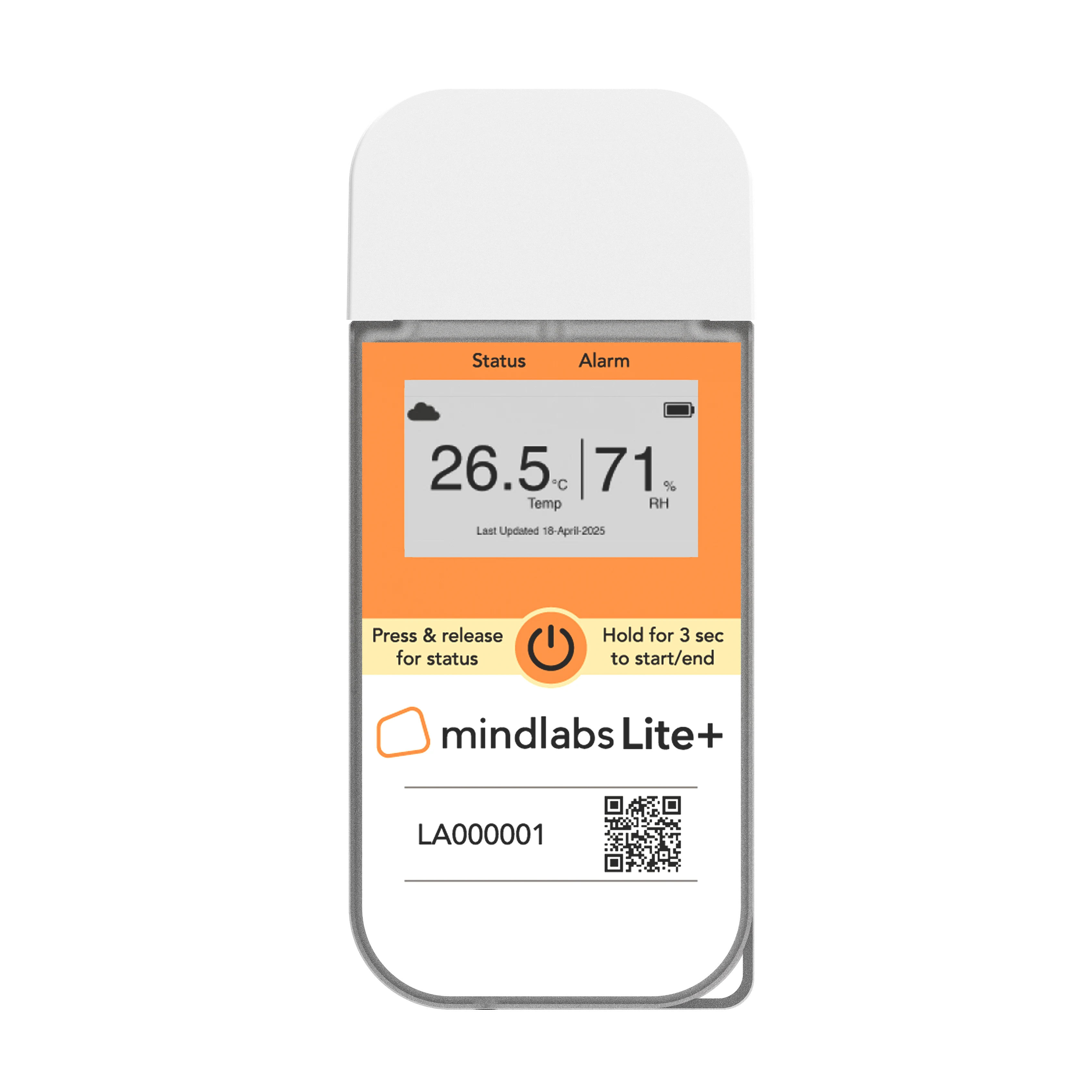
Mindlabs Lite+ is a single-use USB temperature logger that ships inside the consignment, recording continuous temperature and humidity from origin to destination. On arrival, it generates a tamper-evident PDF report and CSV data in minutes, producing a clean, GDP-aligned record — not an investigation.
For teams shipping across multiple jurisdictions, Lite+ delivers the two things the current regulatory regime now expects: a continuous record and defensible evidence. That is what keeps the seven-step sequence from ever starting.
Learn more about Mindlabs Lite+
For high-value shipments where real-time visibility and reroute intervention matter, Mindlabs Go pairs live GPS with condition tracking across every leg of the journey. For a full view of Mindlabs' export-focused monitoring stack, see the pharmaceutical export temperature monitoring solution, the cold chain and warehouse monitoring solution, or the full range of temperature data loggers.
Common questions about deployment, calibration, and platform integration are answered in the Mindlabs FAQ.
Key takeaways
A "rejected consignment" is rarely a single event. It is the start of a documented, procedural sequence that runs on regulatory timelines — quarantine, investigation, stability assessment, disposition, CAPA, deviation closure — that measures in weeks, not hours, and stacks costs across product, investigation, regulatory, downstream, and commercial dimensions.
The sequence is not triggered by the shipment failing. It is triggered by the record failing to prove that the shipment held. And under the current GDP compliance bar — produce-the-evidence, no unaccounted intervals — a passive logger read on arrival can no longer meet that requirement on its own.
The fix is architectural: a continuous, tamper-evident temperature data logger that travels with the consignment, arrives complete, and can be verified in minutes. That is the record the regulator now expects. It is also the record that keeps the seven-step sequence from ever starting.
Conclusion
The most expensive part of a rejected consignment is not the destroyed product. It is the sequence that runs because of the missing evidence — a sequence designed for a world where discovery happened at the destination, in a jurisdiction that now expects continuous documentation across the entire journey. The consignment does not need to have failed. It only needs to have a gap.
The exporters who will operate cleanly through 2026 and beyond are the ones who have moved the temperature record from a document read at arrival to a defence produced on arrival. That is not a monitoring upgrade. It is the new baseline.
Want to see what a GDP-aligned, defensible temperature record looks like on your export lanes? Talk to the Mindlabs team →