The Pharma Export Playbook
Managing pharma cold chain from Indian factory to destination dock (2026)
If you manage pharma exports out of India, your job in 2026 has changed. Not the destinations. Not the products. The bar.
The industry loses $35 billion every year to pharma cold chain failures (IQVIA). Between 2020 and 2024, IATA specifically documented $35 billion in pharmaceutical losses from air transport temperature excursions (Research Square, 2026). India ships more than 60% of the world's vaccine volume and is the largest exporter of generic drugs on the planet (Jeena, 2026). Which means a very large share of that loss is happening on lanes that start in Mumbai, Hyderabad, Ahmedabad, Delhi, or Chennai.
This playbook is written for the logistics manager who owns those lanes. It walks the pharma export journey leg by leg, from the origin factory dock to the final destination consignee. It tells you where the money actually bleeds, what regulators expect in 2026, and what your operational baseline should look like on every lane.
Not "cold chain best practice." Pharma exports, specifically. From India, specifically. In 2026.
The number that reframes everything
IATA has documented that $35 billion in pharmaceutical losses from air-transport temperature excursions occurred between 2020 and 2024 (Research Square, 2026). For an Indian pharma exporter shipping to the US, EU, UK, Japan, or Australia, that is not an abstract industry figure. That is what happens when your lane doesn't hold up.
What makes pharma exports different from every other cold chain
Domestic cold chain teams have one set of rules to follow. Pharma export logistics managers have to satisfy the rules of every jurisdiction their shipment touches — origin, transit, and destination — at the same time.
That is the structural difference. A vaccine leaving Hyderabad for a hospital pharmacy in Frankfurt is judged against Indian export documentation, IATA CEIV Pharma handling standards, EU GDP transport requirements, and destination-country release protocols. Miss any one of them and the consignment sits.
Everything that follows in this playbook assumes that multi-jurisdiction reality. That is the frame that separates a pharma export logistics manager from a domestic cold chain operator.
The export journey — where a consignment actually moves through
A regulated pharma export from India passes through roughly seven distinct legs. Each has its own risk profile, its own owner, and its own documentation requirement.
Leg 1 — Origin factory dock to forwarder pickup
The consignment leaves the manufacturer's controlled environment and enters a validated shipper. Loading dock hold time, ambient exposure during loading, and the freight forwarder's pickup window all count against the packaging's validated hold time.
Where it fails: Excessive dock hold in Indian summer heat. Loading delays that eat into the packaging's 96- or 120-hour rating before the shipment has even left origin.
Leg 2 — Forwarder to Indian departure airport
Ground transport from the forwarder's staging warehouse to the airport cargo terminal. Route-specific reefer transport, driver handling, and the delivery window to the airport cargo acceptance dock.
Where it fails: Reefer trucks arriving with an already-compromised setpoint. Delivery windows that miss the airline's temperature-controlled acceptance schedule and end up in ambient cargo staging.
Leg 3 — Indian departure airport ground handling
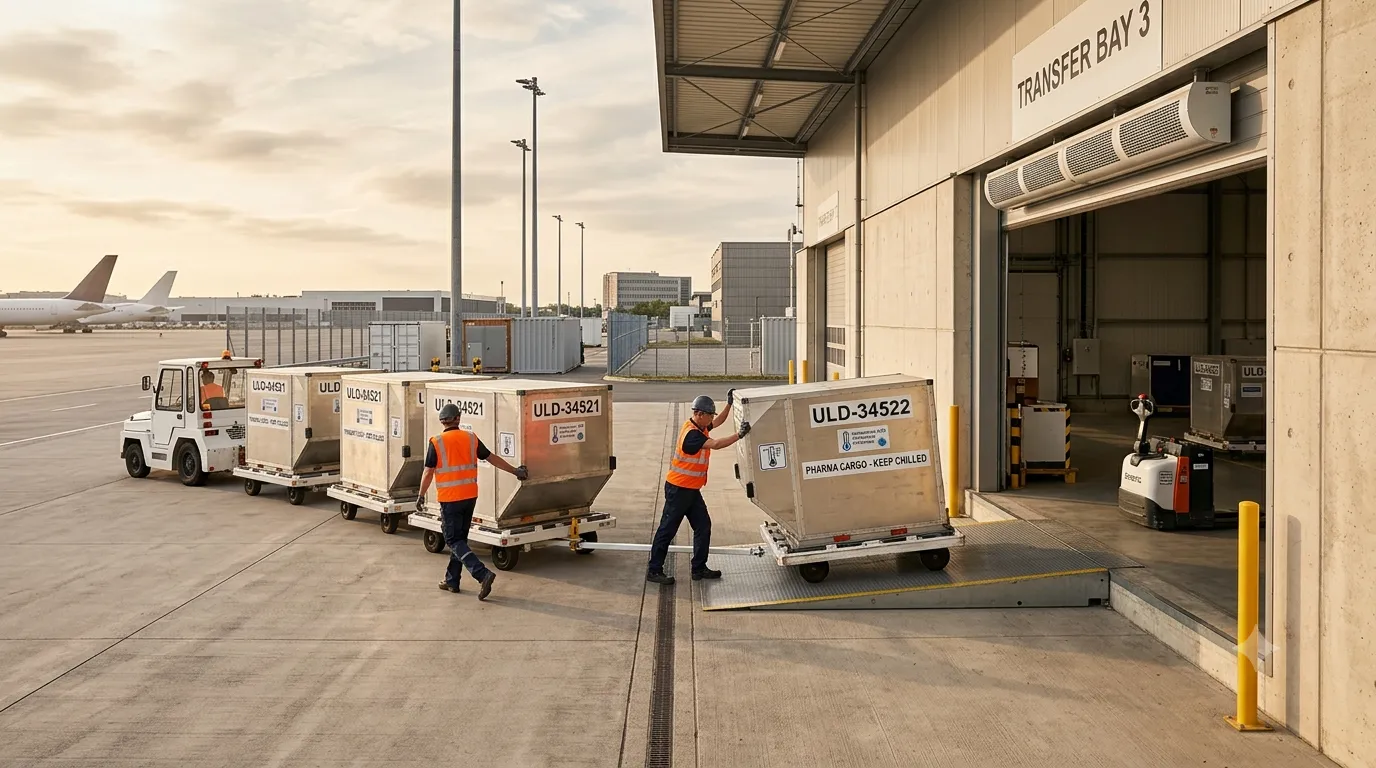
Cargo acceptance, ULD build-up, transfer from the pharma facility to the ramp, loading onto the aircraft. This leg is where the first serious tarmac exposure risk starts.
Where it fails: Extended ULD dwell on the ramp during summer months at Indian departure airports. Loading delays. Ground-handler miscommunication that lands your consignment in general cargo staging instead of the temperature-controlled pharma facility.
Leg 4 — Flight leg (or legs)
The aircraft. Cargo hold conditions vary: main deck 15–25°C during cruise, lower deck 5–15°C, with significant variability by aircraft type and cargo zone (Eupry). Active ULDs manage the gap, but the ULD is only as good as its handling and its power state at each transfer.
Where it fails: Active ULD power interruptions during transfer. Long ground times at multi-leg flights. This is no longer the primary risk leg — see the next section — but it is still a leg that needs monitoring.
Leg 5 — Transit hub ground transfer (the new primary risk window)
At a transit hub — Frankfurt, Amsterdam, Dubai, Doha, Singapore — the consignment is offloaded from one aircraft, moved across the tarmac, held in a temperature-controlled facility, and eventually loaded onto the next aircraft. This ground transfer window is now the primary thermal risk in international pharma air cargo (Research Square 2026, Eupry 2026).
Where it fails: Extended dwell on the tarmac between aircraft offload and cold-room induction. Miscommunication between airline and ground handler that puts the consignment in a standard warehouse. Delays at the pharma facility handoff. Extended time in uncontrolled outdoor conditions accounts for the majority of documented pharma excursions in air cargo.
Leg 6 — Destination airport, customs, and clearance
Arrival at destination, cargo acceptance by ground handler, customs hold, release for pickup by the destination broker or 3PL.
Where it fails: Customs dwell of 48–72 hours that quietly exceeds the packaging's validated hold time. Documentation discrepancies (batch, HS code, CoA) that add 24–48 hours to clearance. Refrigerated hold-room capacity limits at destination facilities.
Leg 7 — Last mile to destination consignee
Delivery from the destination airport or bonded warehouse to the final consignee — a hospital, distributor, or specialty pharmacy.
Where it fails: Courier variation. Vehicles that were fine for domestic distribution but not properly validated for pharma. Delivery windows that extend outside temperature-controlled hours.
That is the journey. Every excursion, every rejected consignment, every failed lane happens on one of those seven legs — or in the handoffs between them, which is where most of the loss now sits.
Where the loss actually happens — the tarmac thesis
Here is the operational insight that reframes pharma export cold chain management in 2026.
For twenty years, cold chain investment in air cargo focused on the aircraft. Better ULDs, better temperature control during cruise, better in-flight monitoring. That work paid off. In-flight thermal control is now, generally, solid.
But the loss did not go away. It moved. Research and industry commentary in 2026 converge on the same finding: the ground transfer window at transit hubs — not the in-flight leg — is now the primary thermal risk window in international pharma air cargo (Research Square 2026; Eupry 2026; IATA-linked commentary via OMG Experience 2026).
Practically, that means:
- Extended tarmac exposure during aircraft loading and unloading
- Delays during ground transfer between the aircraft and the cold room
- Hot-tarmac exposure at Indian departure airports in summer months
- Miscommunication and dwell at destination and transit-hub ground handlers
… now account for the majority of documented pharma excursions in air cargo.
This is why DHL Group announced a €2 billion strategic investment in its airfreight cold chain network in February 2026, including a dedicated Boeing 777 freighter service between Brussels and Cincinnati (Research Square 2026). The investment was explicitly justified by the need to reduce reliance on third-party commercial airlines and exert direct control over the ground handling chain — to minimise the exact exposure this playbook is calling out. When a global forwarder puts €2 billion into ground control, the signal is unambiguous.
The tarmac is the new front line. That is the leg an Indian pharma export logistics manager should be watching hardest in 2026.
Compliance across the export journey — what regulators expect in 2026
A pharma export shipment satisfies more compliance frameworks than any domestic cold chain operation. The stack that matters in 2026:
IATA CEIV Pharma (Center of Excellence for Independent Validators in Pharmaceutical Handling). IATA's certification for pharmaceutical air cargo handlers — airlines, forwarders, ground handlers. Hundreds of organizations are now certified globally, and many regulated-market consignees now require CEIV-certified handlers in the lane (IATA 2026). It is the operational benchmark, not a formality. Your handlers not being CEIV-certified is a lane risk you can quantify.
WHO Good Distribution Practices (GDP). Governs storage, transport, and handling of medicinal products across the whole export journey. Requires validated transport lanes, temperature mapping, continuous data logging (typically at 15-minute intervals), chain-of-custody documentation, and trained personnel — for all three standard bands: 2–8°C (biologics, vaccines, most injectables), 15–25°C (controlled room temperature APIs and finished dose), and -25 to -10°C (frozen, USP <659>).
EU GDP (Guidelines on Good Distribution Practice of medicinal products for human use). For consignments entering the EU, verifiable chain of custody at every transfer point is mandatory. Any unaccounted interval in the temperature record is treated as a potential excursion under review — even if the product was actually fine.
US 21 CFR Part 11. For consignments entering the US market, electronic records and audit trails must meet FDA data integrity, security, and electronic records equivalency requirements. Real-time platforms producing tamper-evident audit trails — such as Mindlabs' 21 CFR Part 11-compliant monitoring — are becoming the operational baseline for US-bound consignments.
USP <659> and USP <1079>. United States Pharmacopeia chapters governing cold storage temperature ranges and good storage/distribution practices.
Destination inbound regulators. MHRA (UK), CDSCO (India inbound), TGA (Australia), PMDA (Japan), WHO PQS (for prequalified programmes). Each has its own inbound documentation expectations layered on top of the frameworks above.
The practical reality: a Hyderabad-to-Frankfurt biologic shipment must satisfy Indian export documentation, IATA CEIV Pharma handling standards, EU GDP transport requirements, and EMA release protocols — all simultaneously, all documented, all producible on demand at any leg.
Verbal assurance from a courier that they kept it cold no longer counts anywhere in the stack.
India's export scale — why this matters at the country level
India supplies more than 60% of global vaccine volume and is the largest exporter of generic drugs in the world (Jeena 2026). The global cold supply chain market crossed $316 billion in 2024 (WhyLoyalty 2026). Growth is fastest in biologics, biosimilars, and specialty drugs — the categories with the narrowest temperature tolerance and the highest rejection cost per lane failure. Indian export volumes are climbing, unit values are climbing, and destination scrutiny is tightening at the same time.
The visibility problem — carrier milestones vs. condition data
Here is the operational blind spot that hits every pharma export logistics manager sooner or later.
Carrier-reported milestones tell you where the box was scanned. They do not tell you what condition it was in between scans. When an excursion is discovered on arrival — which is when most of them are discovered, if the logger was passive — you cannot correlate the deviation to the transit timeline. Was it in-transit? At a carrier handoff? During a customs dwell? During the tarmac window at the transit hub?
That correlation is what a CAPA investigation actually needs. It is also the piece that most general-purpose visibility tools cannot produce (Paxafe 2026).
Fixing a lane failure you cannot locate is guesswork. Guesswork does not close audit findings, does not satisfy destination regulators, and does not stop the same failure from recurring on the next shipment.
The fix is not a better logger read at destination. It is a continuous, real-time record that travels inside the consignment across every leg of the journey — through the forwarder, the airline, the transit-hub ground handler, customs, and the last-mile carrier. One record. Owned by the shipper. Independent of whichever carrier holds the shipment at any given moment.
Lane mapping — the operational discipline that separates high-performing pharma export operations
Lane mapping is the practice that turns pharma export cold chain management from reactive to proactive. It documents every handoff, transit mode, facility, climate exposure, and transfer point across a specific shipment route (LifeScience Logistics 2026).
Once a lane is mapped, high-risk handoffs become visible — usually the transit-hub ground transfer window and destination customs dwell — and mitigation gets designed lane by lane. Route-specific packaging, targeted carrier and hub selection, pre-departure risk scoring, and lane-specific validation all follow from a mapped lane.
A Hyderabad-to-Newark biologic lane and a Mumbai-to-Frankfurt biosimilar lane are not the same operational problem. They should not carry the same packaging validation, the same carrier list, or the same monitoring policy. Generic lane management is why most in-transit excursions cluster on lanes that "looked fine on paper."
If your team is not lane-mapping in 2026, your operational picture is out of date.
The 2026 tech shift — trackers with cargo, not on the reefer
Three technology categories are converging into the modern pharma export stack (Paxafe 2026):
Continuous IoT condition sensors that travel with the cargo, not the transport asset. This is the critical distinction. A tracker on the reefer stops being useful the moment the consignment is transferred to a different container, offloaded to a bonded warehouse, or moved by a different carrier. A tracker inside the consignment continues recording across every reefer swap, every trailer change, every handoff. For pharma exports specifically — which pass through many carriers and many transfer points — the "with the cargo" architecture is now the operational baseline.
AI risk scoring on lane history and weather. Predictive analytics flags excursion-prone lanes and handoff points before the shipment departs, informing carrier and route choices. Customs dwell and tarmac exposure are the two patterns that show up consistently across risk-scored lanes (Pharmaceutical Commerce 2026).
Real-time transportation visibility (RTTV) platforms. Consolidating carrier milestones, sensor data, and ERP records into one shipment record — so an excursion can be correlated against the transit timeline in real time. This is what closes the "which leg?" investigation gap.
The industry is moving away from buying these as three separate point solutions. Integrated stacks are the direction of travel.
What "operational baseline" looks like on Indian pharma export lanes in 2026
Concretely, if you run pharma exports out of India today:
- Every high-value consignment should carry an in-transit condition record. Not just a reefer log. Not a passive logger read on arrival. An active record that transmits during transit, so a developing excursion at a tarmac dwell, transit-hub handoff, or customs hold can be caught while there is still a window to act.
- Every export lane should be mapped — handoffs, climate exposure, transit-hub dwell risk, destination customs history.
- Every carrier and handler on regulated-market lanes should be CEIV Pharma-certified.
- Every temperature record should be tamper-evident and audit-ready on arrival — not compiled after a deviation report has been raised at the destination dock.
Anything less exposes the shipper to the $35 billion problem the industry has already documented.
Mindlabs Go and Lite+ — built for pharma export lanes
Mindlabs makes two products that fit the export journey directly.
Mindlabs Go — real-time GPS and condition tracking that travels with the cargo
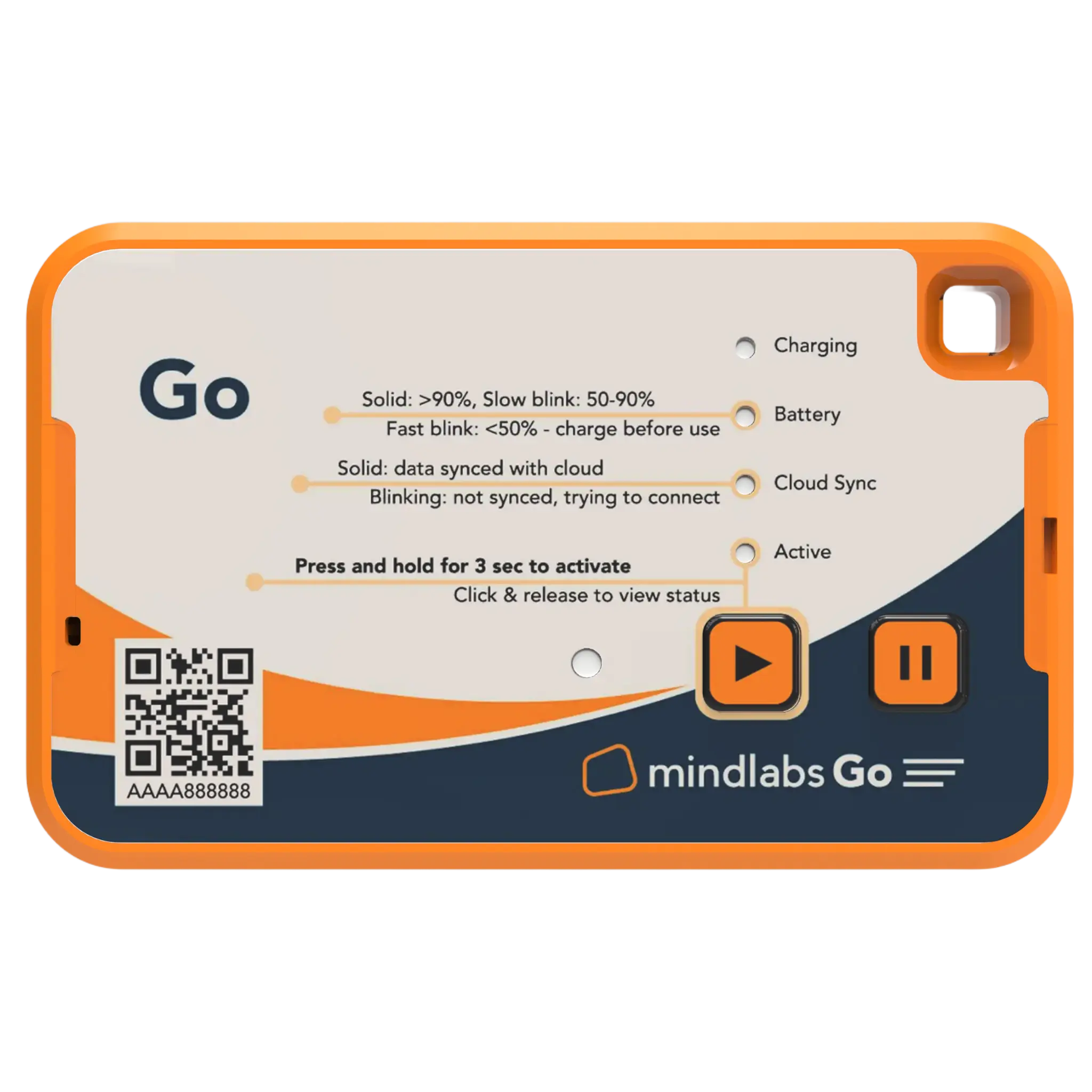
Mindlabs Go is a real-time shipment tracker that travels inside the consignment and monitors location and condition continuously across every leg of the export journey — through the forwarder, the Indian departure airport, the flight leg, the transit-hub ground transfer, destination customs, the destination warehouse, and the last-mile carrier.
When a developing excursion happens during a ground-transfer window at Frankfurt or a customs dwell in Newark, Go surfaces it in real time — while there is still a window to reroute, adjust reefer settings, or coordinate a safe-release decision on arrival. It closes the "which leg?" blind spot with a continuous, tamper-evident record owned by the shipper, not by any single carrier.
Mindlabs Lite+ — a single-use tamper-evident record for every consignment
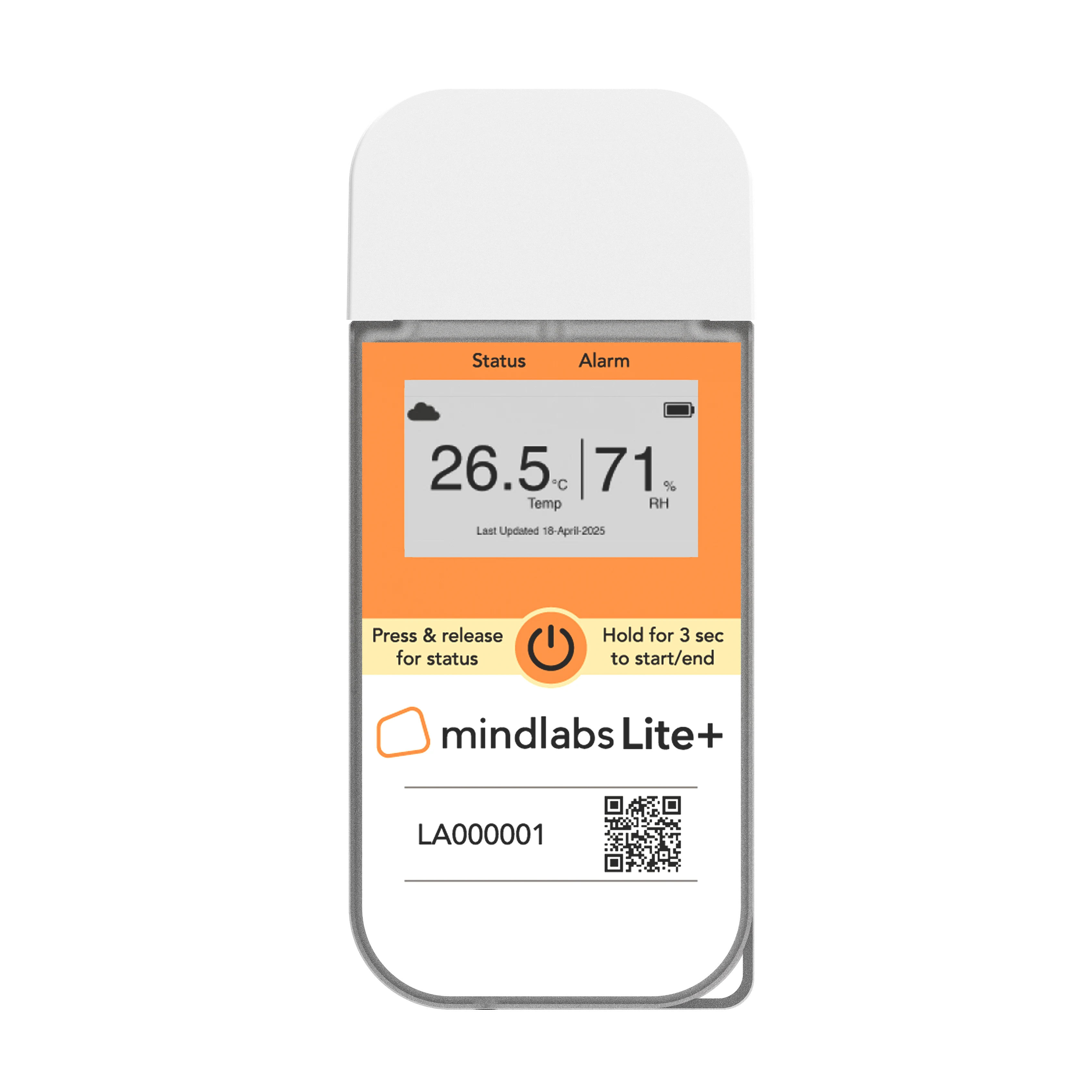
Mindlabs Lite+ is a single-use USB temperature logger designed for high-volume pharma export consignments. It ships inside the box, records continuous temperature and humidity from origin to destination, and produces a tamper-evident PDF report and CSV data on arrival. Plugged in on the receiving dock, it delivers a clean, GDP-aligned record in minutes — no investigation, no stability hold, no "we think it was fine."
For a full view of Mindlabs' export-focused monitoring stack, see the pharmaceutical export temperature monitoring solution, the cold chain and warehouse monitoring solution, or the full range of temperature data loggers. Deployment and integration questions are answered in the Mindlabs FAQ.
Key takeaways for the 2026 pharma export logistics manager
- The loss is on the ground. The tarmac and ground-transfer window at transit hubs is now the primary thermal risk in international pharma air cargo. Design your lane risk model accordingly.
- Carrier milestones do not equal condition data. A scan tells you the box moved. It does not tell you what happened to the product between scans.
- Lane mapping is not optional. In 2026, running an unmapped export lane is running a lane you cannot risk-score.
- Handlers on regulated-market lanes should be CEIV Pharma-certified. This is no longer a differentiator. It is now what regulated-market consignees expect.
- Trackers inside the consignment beat trackers on the transport asset. Every handoff resets the value of a tracker attached to a reefer or a ULD. Only the cargo itself sees the whole journey.
- Tamper-evident, real-time, GDP-aligned records are the operational baseline. Everything less will fail an audit or a release decision on some lane, on some day.
Frequently asked questions
Do all Indian pharma exports need IATA CEIV Pharma-certified handlers?
For consignments entering the US, EU, UK, Japan, or Australia, most regulated-market consignees now expect CEIV Pharma-certified handlers in the lane. It is treated as an operational baseline for regulated-market lanes rather than as a certification of last resort. Certification levels and enforcement vary by consignee and lane.
What are the standard temperature bands for pharma exports from India?
The three primary bands are 2–8°C (biologics, vaccines, most injectables), 15–25°C (controlled room temperature APIs and finished dose), and -25 to -10°C (frozen, per USP <659>). Advanced cell and gene therapies increasingly require -80°C ultra-cold handling.
Where do most pharma export temperature excursions actually happen in 2026?
Based on multiple 2026 sources, the majority of documented pharma cold chain excursions in air cargo now occur during ground transfer windows — extended dwell at aircraft loading and unloading, transfer between the aircraft and the cold room at transit hubs, and tarmac exposure at hot-climate airports (Research Square 2026, Eupry 2026). In-flight temperature excursions have declined significantly over the last decade as aircraft handling improved.
What is the difference between a passive data logger and a real-time tracker for pharma exports?
A passive logger records temperature during transit but can only be downloaded and read after arrival. It documents excursions after the intervention window has closed. A real-time tracker transmits data during transit, so an excursion at a tarmac dwell, a transit-hub handoff, or a customs hold can be detected while there is still time to act — reroute, adjust reefer settings, or coordinate a safe-release decision at the destination dock (Tive 2026).
Is GDP-compliant temperature documentation mandatory for pharma exports from India?
For any shipment entering a regulated market — US, EU, UK, Japan, Australia, and increasingly others — GDP-aligned documentation is expected as a baseline. Under EU GDP specifically, any unaccounted interval in the temperature record is treated as a potential excursion until proven otherwise, and can trigger investigation, quarantine, or destruction of the consignment on arrival.
What is lane mapping and why does it matter for pharma exports?
Lane mapping documents every handoff, transit mode, facility, climate exposure, and transfer point across a specific export route. Once mapped, high-risk points — usually transit-hub ground transfer and destination customs — become visible, and mitigation can be designed lane by lane rather than generically. A Hyderabad-to-Newark biologic lane and a Mumbai-to-Frankfurt biosimilar lane are not the same operational problem and should not share the same packaging, carrier, or monitoring policy.
Conclusion
Pharma exports from India are no longer a back-office logistics function. In 2026, they are the single biggest determinant of whether Indian biologics, vaccines, and specialty medicines reach their global destinations in a commercially and clinically viable state. The industry loses $35 billion a year to temperature excursions. Most of that loss is not happening in the air. It is happening in the ground transfer windows and handoffs that pharma export logistics managers now own.
The Indian exporters who will operate cleanly through 2026 and beyond are the ones who have mapped their lanes, put in-transit condition records inside every consignment, and moved from "the shipment was fine when it left us" to "here is the record that proves it was fine on every leg." That is the shift the industry is making. It is also the shift regulators are enforcing.
Want to see what an audit-ready, GDP-aligned in-transit temperature record looks like on your Indian pharma export lanes? Talk to the Mindlabs team →