Every CRO Just Got a Second Auditor. It's Their Sponsor — and E6(R3) Made It Legal.
How ICH E6(R3) changed CRO oversight in 2026 — and what it means for a lab head's data
If you run a bioanalytical, stability, or central lab inside a CRO, you already know the audit pressure. FDA GLP inspections. Sponsor QA visits. Ad-hoc data requests when a study lead is preparing a submission. That was the job.
In 2026, it is not the job anymore. It is half the job.
ICH E6(R3), finalised in January 2025 and adopted by the EU (July 2025), the FDA (September 2025), and now legally binding in the UK from April 2026, did something structural: it made sponsor oversight of CROs a regulatory obligation, not a business preference. Under new Section 3.9, sponsors are required to evidence proactive oversight of every CRO they work with. Ultimate responsibility for the quality and integrity of trial data now rests, in writing, with the sponsor — even for tasks the sponsor delegated.
Which means when a sponsor's QA team asks your lab for continuous, verifiable environmental data covering three specific freezers on twelve specific dates, they are no longer asking as a courtesy. They are asking because their own regulator will ask them the same question, and they need to be able to answer it.
Your lab now has two auditors. This article is about what that changes.
Industry Insight
Data integrity was cited in 60%+ of FDA warning letters across multiple years, and 99% of 2025 warning letters contained citations related to documentation, records, or written procedures (industry regulatory analysis, 2025–2026). In 2025 alone, FDA issued enforcement actions to at least three named GLP CROs — Jiangsu Kerbio, CCIC Huatongwei, and Vedic Lifesciences — with data integrity as the most common category of critical findings.
The audit isn't where you're looking
For most of the last decade, CRO lab heads prepared for one kind of scrutiny: the regulator. FDA BIMO inspections. EMA GCP inspections. National agency GLP visits. Those are still happening — and still generating 483s, warning letters, and study rejections.
But the more consequential scrutiny is now coming from the party paying the invoice.
Under E6(R3) Section 3.9, sponsors must run risk-based oversight of every delegated function, including bioanalytical and lab work. They must be able to evidence that oversight to their own auditors. And what they need to evidence is not summaries or attestations — it is the same underlying data your lab holds. Timestamped. Audit-trailed. Verifiable.
The old model — a sponsor audit once a year, a data package delivered at study close, everyone signs the CSR — no longer meets the E6(R3) bar. Sponsors are being told, in writing, that a final quality review at closeout is not enough. They must build oversight into the trial from day one, with running visibility into critical-to-quality data.
For your lab, that changes the sponsor from a periodic auditor into a continuous one.
Why sponsor oversight is different from a regulatory audit
The two audits look similar on paper. In practice, they behave very differently — and CRO lab heads underestimate the second one until they hit it.
Sponsor audits are contract-terminating, not just corrective. A regulator issues a 483, gives you time to respond, and escalates only if unresolved. A sponsor's QA team does not need to escalate. They just do not renew the master service agreement. The Herman analysis of sponsor-CRO relationships — still widely referenced — names "lack of transparency" and "trust issues" as the most common quiet contract-killers. E6(R3) formalises that same instinct into a regulatory requirement.
Sponsor audits are on-demand, not scheduled. A regulatory inspection has notice, a scope, and an inspection plan. A sponsor's oversight request can arrive at 9 a.m. Monday asking for the temperature record of Freezer 7, days 43 through 57 of Study MB-2201, at 15-minute resolution. If your monitoring system can produce that in an hour, you keep the sponsor. If it takes three days and involves Excel exports, you have already answered the question the sponsor was really asking.
Sponsor audits target data lifecycle, not endpoints. A regulator often audits outcomes: were samples analysed correctly, was the assay validated, was the report accurate. A sponsor's E6(R3) oversight targets the lifecycle: was the temperature record continuous from sample receipt through analysis, was it tamper-evident, was it retrievable years later without vendor risk. These are Part 11 questions in operational clothing.
The gap between a regulator's audit and a sponsor's oversight, in short, is the gap between did it pass and can you prove it, on my timeline, in the form my own regulator will accept from me.
A real example: what a 2025 CRO warning letter actually looked like
Consider the January 2025 FDA warning letter issued to Jiangsu Kerbio, a Chinese GLP CRO performing medical device safety tests. The FDA's Office of Bioresearch Monitoring reviewed 67 studies. The critical findings — the ones that made the letter public — were data integrity issues.
A separate February 2024 warning letter to Amman Pharmaceutical Industries (Jordan) named the issue plainly: "lack of data integrity in environmental monitoring records" and "persistent deficient environmental controls." The letter attributed the failures to "system design flaws" — not to a specific incident, but to the way the environmental monitoring stack was built to begin with.
Neither of these labs failed because a freezer excursed on a specific day. They failed because when an inspector asked for continuous, verifiable, audit-trailed environmental data, the records could not stand up to the request. The data existed. It was not defensible.
That is the pattern showing up across CRO enforcement in 2024–2026. And it is the exact pattern an E6(R3)-obligated sponsor will now be looking for, on their own initiative, without waiting for a regulator to find it first.
Real Data Insight
The most common 483 findings in laboratory data integrity are not dramatic falsifications. They are structural: audit trails not enabled on critical systems, shared login credentials, timestamps out of sync between sensor and server, unvalidated spreadsheets used as records, and backup verification gaps. Regulatory assessments consistently find that 40 to 60% of pharmaceutical manufacturers have significant Part 11 gaps — primarily in audit-trail completeness, electronic signature implementation, and system validation.
Where FDA and sponsor scrutiny now converge
For a long time, 21 CFR Part 11 and sponsor oversight sat in separate operational domains. Part 11 was an IT/QA problem — audit trails, electronic signatures, computerised system validation. Sponsor oversight was a study conduct problem — protocol adherence, deviation management, monitoring visit metrics.
E6(R3) collapsed the distinction. Sponsors are now explicitly required to oversee the data lifecycle, including audit trails, secure data transfers, retention, and computerised system validation. And ICH E6(R3) Annex 1, which the FDA adopted in September 2025, mandates access delegation, incident reporting, and system-defect visibility for every computerised system used in a trial — including environmental monitoring systems that produce the records a bioanalytical or stability lab depends on.
Which means the questions your sponsor's auditor will ask look almost identical to the questions an FDA inspector will ask:
- Is the audit trail enabled on every critical system?
- Are timestamps synchronised across sensor, gateway, server, and LIMS?
- Are electronic records tamper-evident and retrievable for the full regulatory retention period?
- Are user actions attributable to named operators, not shared logins?
- Is the environmental monitoring system validated?
Historically, a CRO lab head could answer these questions once a year, at audit time. Under E6(R3), the answer needs to be produceable in an hour, on any Monday, for any freezer, for any study.
The fix: environmental data your second auditor can actually verify
The instinct after a 483 is to write more procedures. The instinct after a sponsor's concerned email is to write more reports. Neither closes the gap E6(R3) created. What closes it is architectural: an environmental monitoring stack that produces continuous, granular, tamper-evident, Part 11-aligned records by default, retrievable on demand, without an Excel export in sight.
Not because a lab head wants a nicer dashboard. Because the record the sponsor's auditor will ask for is now, structurally, the record the FDA inspector will ask for. Building for one builds for both.
Mindlabs Anchor (fixed environmental monitoring)
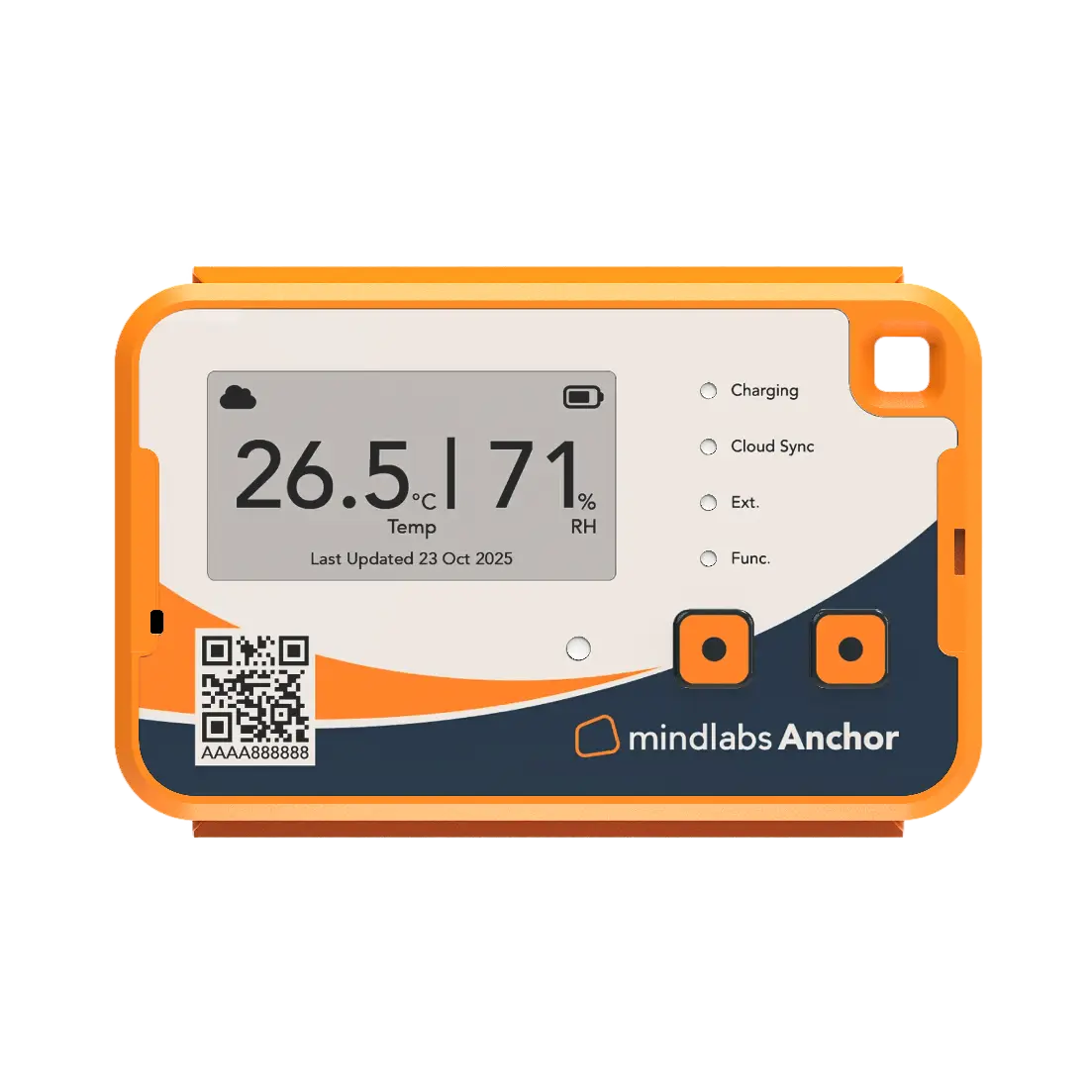
Mindlabs Anchor is a fixed environmental monitoring solution built for pharmaceutical and CRO labs where the record has to stand up to audit. It provides continuous, calibrated temperature and humidity monitoring across ultra-low freezers, -20°C freezers, 2–8°C refrigerators, stability chambers, and controlled-environment rooms — with tamper-evident audit trails, named-user attribution, and 21 CFR Part 11-aligned electronic records designed to be produceable on demand.
When your sponsor's QA team asks for the temperature history of Freezer 7 across a specific window, at 15-minute resolution, with an audit trail showing who accessed the data and when, Anchor produces it. The record is continuous, granular, and defensible — not compiled after the request, but always available.
Learn more about Mindlabs Anchor
Industry Insight
Continuous, audit-trailed environmental data does more than pass an inspection. It also protects the lab: when an anomaly is flagged and investigated, a granular record allows the investigation to establish exactly what happened, when, and to which samples — which often demonstrates that no compromising excursion occurred at all. Anchor's audit trail turns environmental data from a compliance liability into a defensible exhibit.
What this changes for a CRO lab head
E6(R3) is not just a paperwork update. It changes how a lab head has to think about data, on four practical dimensions.
You get one system of record. Instead of stitching together freezer logs, chart recorders, Excel sheets, and paper backup files when a sponsor asks, you hold a single, continuous, retrievable record of every asset. When the ask comes, you answer it in the sponsor's timeframe, not yours.
You can defend the record, not just present it. With named-user attribution and tamper-evident audit trails, "here is the data" also means "here is who accessed it, when, and what changed." That is the standard both Part 11 and E6(R3) now expect.
You reduce contract risk, not just inspection risk. Sponsor concern about oversight quality is now the single largest quiet cause of contract non-renewal in CRO relationships. A lab that produces sponsor-ready data on demand answers the question the sponsor was really asking — can we trust you with the next study.
You align regulator and sponsor prep into one workflow. The audit trail an FDA inspector needs is the audit trail your sponsor's E6(R3) oversight programme needs. Building one covers both. You stop preparing twice.
Key takeaways
E6(R3) made sponsor oversight of CROs a regulatory obligation, not a client courtesy. In 2026, your data faces two auditors — the regulator, and the sponsor who is legally accountable for the quality and integrity of trial data. The two audits are converging on the same underlying question: can your environmental record be produced, on demand, in a form that is continuous, granular, tamper-evident, and audit-trailed. The pattern in 2024–2026 CRO enforcement — Kerbio, Vedic, Huatongwei, Amman Pharmaceutical — is not about incidents that happened. It is about records that could not stand up when asked. The fix is architectural: an environmental monitoring stack that produces defensible data by default, so the answer to any question — from a regulator or a sponsor — is already available before the question is asked.
Conclusion
The regulator was never the only audience for CRO environmental data. In 2026, they are just the more visible one. The quieter audience — the sponsor's QA team, now legally required under E6(R3) to prove they had continuous oversight of your work — is the one that decides whether the next master service agreement gets signed. Both are asking the same question in different words: can you produce the record, right now, and will it hold up. In a regulatory environment where 99% of 2025 warning letters cite documentation gaps and where sponsor oversight is now a legal obligation, "we had monitoring" is no longer the answer. "Here is the audit-trailed, continuous, Part 11-aligned record — retrieved in ten minutes and defensible for the full retention period" is.
Wondering whether your current environmental monitoring stack would stand up to an on-demand sponsor request under E6(R3)? Talk to the Mindlabs team about putting continuous, audit-trailed environmental data behind every study your lab runs.