
You Can Run a Clean CRO and Still Get Pulled Into Someone Else's Inspection.
Why CPGM 7348.810 puts every CRO one week away from an FDA visit — and what readiness actually looks like
Ask a CRO Quality Head what they lose sleep over. Very few will say our own compliance. Most will say the same thing. The phone call about somebody else's mistake.
A site missed a lab draw. A sponsor delegated something they shouldn't have. A monitor filed something late. And now, because of a chain that started nowhere near your CRO, an FDA investigator is booked to walk into your office in seven business days.
That is the situation this article is about. Not the CRO that failed an audit. The CRO that ran a clean study — and still got pulled in because someone else didn't.
Industry Insight
FDA's Bioresearch Monitoring (BIMO) program conducts hundreds of sponsor, CRO, and monitor inspections each year across drugs, biologics, and devices. The realistic notice window for an unanticipated CRO inspection is five to ten business days — a window every published FDA-readiness case, including the ProTrials case discussed later in this article, treats as the operational baseline. Recent enforcement — including the late-2024 Applied Therapeutics action, where audit trail deletion led to a Complete Response Letter, warning letter, and CEO resignation — makes clear that FDA is now inspecting deeper into computerized systems and asking harder questions about who accessed what data, when.
Where the inspection actually starts
Most CROs assume FDA shows up because they did something wrong. That is not how the manual works.
FDA field investigators run sponsor and CRO inspections against Compliance Program Guidance Manual 7348.810 — Sponsors, Contract Research Organizations, and Monitors (part of the Bioresearch Monitoring, or BIMO, program). It is public. It tells investigators what to check, in what order, at any organization involved in an FDA-regulated trial.
Two things about 7348.810 matter for a Quality Head:
One — it explicitly instructs investigators to look up the chain, not just at the party they're inspecting. Investigators check whether the sponsor vetted the CRO's compliance ability before delegating work. They check whether monitoring activities were carried out according to the sponsor's or the CRO's procedures. If the answer to either question is uncertain, the inspection widens. Your CRO doesn't have to have done anything wrong to be next.
Two — CRO inspections can be triggered by a site event or a sponsor issue, not by anything you did. A CRA finding at a site, an IRB action, or a serious deviation reported to FDA can pull the CRO into the review, because 7348.810 treats sponsors, CROs, and monitors as a linked system. Investigators are trained to follow the chain.
That is the structural risk. You didn't cause the problem. You still get investigated for it.
Why a clean CRO gets pulled in anyway
There are three common paths. All of them start somewhere other than your CRO.
The site-failure path. A monitoring visit finds a site did not perform required assessments. The CRA files it. The IRB reviews it. If the IRB determines the finding is serious, FDA can be notified — and the resulting inspection typically covers the site and the CRO managing the study. Not because the CRO caused the miss, but because 7348.810 wants to know how the CRO's monitoring caught it, escalated it, and documented the response.
The sponsor-delegation path. Under ICH E6(R3), finalized in January 2025 and now the operational bar for sponsors globally, sponsors carry ultimate responsibility for data integrity even when they delegate work to a CRO. When a sponsor gets inspected, the sponsor's delegation records, oversight logs, and CRO qualification files come out. If any of them look thin, the inspection route naturally extends to the CRO. The CRO's own compliance is not the trigger. The sponsor's oversight paperwork is.
The data-audit-trail path. When an inspector reviews any electronic record from a trial — a lab result, an eCRF entry, an environmental log — the audit trail is where they land. If the audit trail is incomplete, missing, or inconsistent, the trace goes to whoever holds the underlying system. A shared LIMS. A centralized monitoring platform. Environmental monitoring data on a CRO server. Any of them can put your CRO on the inspection map.
Any one of those three paths can put an inspector in front of your Quality Head with roughly a week's notice. And your defense is not going to be "we were not at fault." Your defense is going to be everything you did and documented before the phone rang.
A real example: ProTrials Research
A published case study from ProTrials Research illustrates the pattern.
A US-based clinical-stage biopharmaceutical company was running a Phase II multicenter trial in metastatic renal cell carcinoma. One clinical site failed to perform required lab assessments for three patients. ProTrials' monitoring CRA discovered the miss and reported it. The IRB reviewed the finding and audited the site. The IRB audit findings ultimately led to an FDA site inspection.
ProTrials had not caused the site's failure. Its own CRA had found it and reported it, doing exactly what a monitoring CRO is supposed to do. That did not exempt ProTrials from involvement. The CRO had roughly one week to prepare for the unanticipated FDA inspection — the CRA delivered additional site training on the required lab assessments, and ProTrials made sure the regulatory files and monitoring records were ready before the inspector walked in. The finding stayed with the site. ProTrials walked away clean.
The lesson is not that ProTrials was special. The lesson is that they had one week — the minimum realistic window an unanticipated CRO inspection tends to give — and everything they needed was already in place. Nobody was building an audit trail during that week. They were producing the one that already existed.
Real Data Insight
The determining factor in whether a Quality Head survives an unanticipated inspection is almost never the absence of issues elsewhere in the study. It is whether the CRO holds a complete, retrievable, tamper-evident evidence base on the day the inspector walks in. Recent FDA-readiness analyses of BIMO inspections consistently identify the same handful of items as inspection-outcome differentiators: audit trail completeness on all computerized systems, environmental monitoring records produceable at defined resolution and date range, named-user access records for every data touch, and documentation that shows the CRO's monitoring caught what it was supposed to catch.
What a Quality Head is actually holding when the inspector walks in
Ask any Quality Head who has been through an unexpected inspection what mattered on day one. It is almost never a better SOP. It is a set of records that were already there — and that the QH could hand over without a scramble.
Five things sit at the top of the list.
A complete environmental monitoring record. For every asset. For every date. At the resolution the inspector asks for. Freezers. Refrigerators. Stability chambers. Controlled rooms. If any of them has a gap, that becomes the question.
An audit trail that survives the question "who touched this." Every access, every change, every timestamp. Attributable to a named user. Not a shared login. Not a service account. Not an Excel export from an offline logger.
A validation package for the monitoring system itself. Under 21 CFR Part 11-compliant monitoring requirements, and under ICH E6(R3) Annex 1, the system producing the record has to be validated. Not just the record. The system.
A retention window that covers the full regulatory period. With no gaps, no rebuilds, no "we migrated systems in 2023 and the older data lives somewhere else."
A monitoring procedure trail that shows the CRO acted on findings — including findings from someone else. This is what protected ProTrials. Their CRA caught the site issue, reported it, and documented the response. When the inspector arrived, that trail was already there.
If a Quality Head is holding all five of those on the day the phone rings, the inspection is manageable. If any of them takes days to pull together, the inspection is not manageable. That is the operational difference between a clean inspection and a bad one.
Mindlabs Anchor — the exhibit you hand over before it's asked for
The five items above sound like paperwork. They aren't. They're outputs of an environmental monitoring stack that either produces them by default, or doesn't.
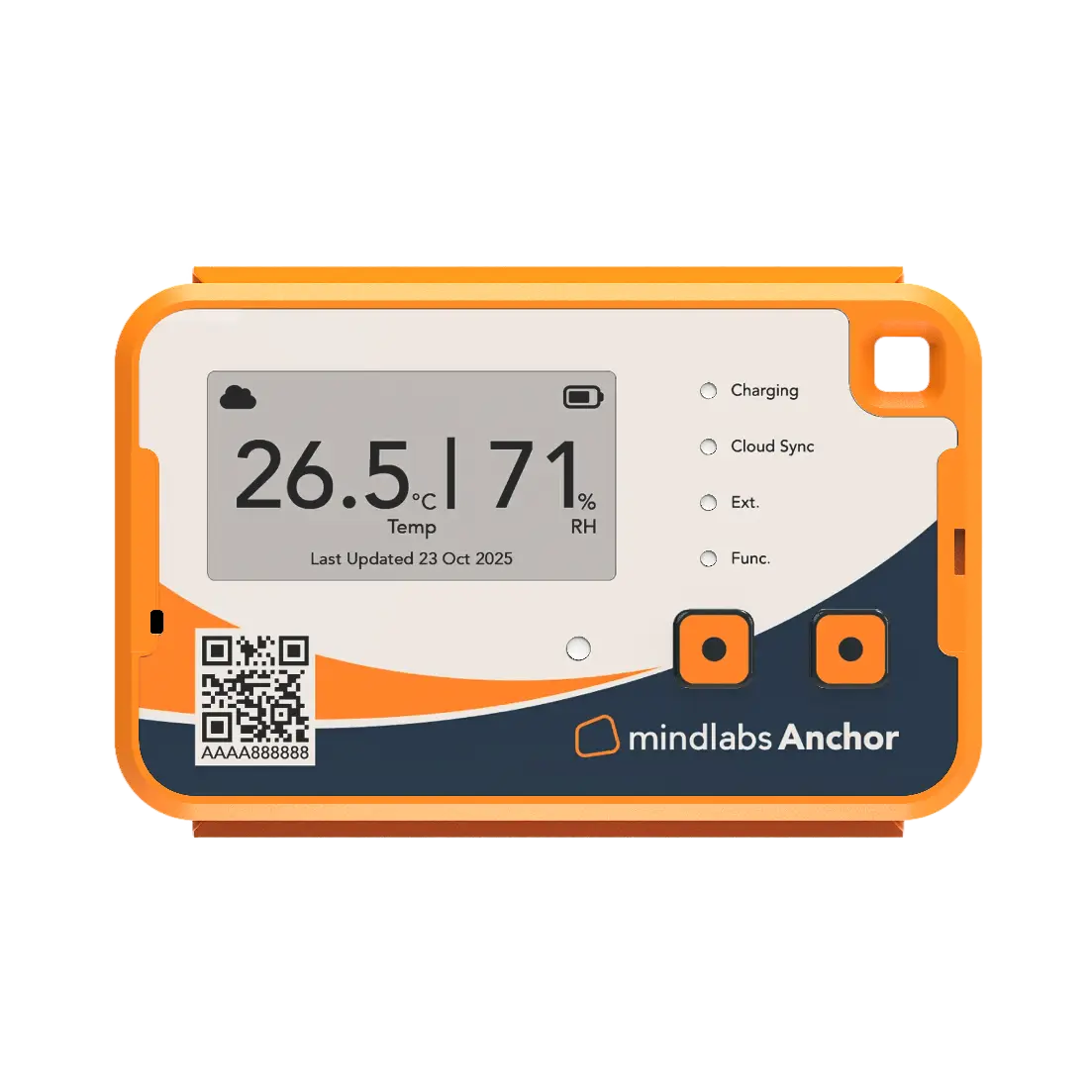
Mindlabs Anchor is a fixed environmental monitoring solution built for CRO facilities where the record has to be ready before the phone rings. It is a wireless temperature data logger and humidity data logger stack that runs on Wi-Fi or 4G, streams to a cloud based temperature monitoring platform continuously, and produces tamper-evident audit trails, named-user attribution, and 21 CFR Part 11-aligned electronic records by default.
For a Quality Head, that changes what happens when the inspector walks in.
IoT temperature monitoring across ultra-low freezers, -20°C freezers, 2–8°C refrigerators, stability chambers, and controlled-environment rooms sits in one platform. Remote temperature monitoring means the record exists whether the QA team is in the facility or a Quality Head is fielding a call from a sponsor at 9 a.m. Monday. When an inspector asks for the temperature history of a specific asset, across a specific window, at defined resolution, with an audit trail showing who accessed the data and when — Anchor produces it. Not in days. In minutes.
Anchor is not the reason an inspector arrives. It is the exhibit the Quality Head can hand over on day one, so that the reason they arrived stays isolated to the party that caused it.
For a broader look at how Anchor fits alongside other lab and pharma monitoring workflows, see the temperature monitoring solution or the pharmaceutical temperature monitoring overview.
The one-week test
Every CRO Quality Head should ask themselves one question about their environmental monitoring stack. If an FDA investigator called on Monday and asked for continuous, audit-trailed environmental data covering three specific assets across twelve specific dates, could I hand it over by Friday — in a form that includes named-user access records and validated timestamps? If the honest answer is "we could get most of it, but it would take some compiling" — that is the gap Anchor is built to close.
What this changes for a CRO Quality Head
Being ready for someone else's inspection is not about writing more procedures. It is about running the CRO in a way that keeps you ready without extra effort.
You survive inspections you weren't expecting. The realistic difference between a Quality Head who survives a site-triggered inspection and one who doesn't is not the site's mistake. It is what was already in place on the CRO side when the phone rang. An environmental monitoring stack that produces the record by default is what makes an unanticipated inspection manageable rather than survivable.
You isolate findings to their source. When an inspector arrives following a site event or a sponsor issue, a Quality Head with complete, retrievable, tamper-evident records can demonstrate — not argue — that the CRO discharged its own responsibilities. That is what keeps the finding attached to the party that caused it, and keeps the inspection from widening.
Your CAPA response starts on day one, not day eight. With continuous audit-trailed data already in place, the root cause analysis for anything the inspector flags doesn't wait for records to be reconstructed. The evidence base for CAPA is already there. Which means the response letter goes out in the window FDA expects, not the one you scrambled to hit.
You buy your team back their week. The realistic difference between an audit-ready CRO and an audit-scrambling CRO is not the outcome. It is what the week before the inspection looks like. A Quality Head with a Part 11-aligned monitoring stack spends that week running the business. A Quality Head without one spends it compiling records for questions they haven't been asked yet.
Key takeaways
FDA does not only inspect the CRO that failed. Under CPGM 7348.810, an FDA inspection can begin because of a site failure, a sponsor issue, or an audit trail question — and reach a CRO that had nothing to do with the underlying event. The realistic preparation window is measured in days, not weeks. The published ProTrials case demonstrates the pattern. A CRO that had reported a site's miss, that had done nothing wrong itself, still got pulled into the resulting FDA inspection and had one week to prove it. What separated the outcome from a bad one was not defensibility of argument. It was defensibility of record — continuous, granular, tamper-evident environmental data that already existed before the call came. The way to run a CRO that survives someone else's mistake is not to argue about fault. It is to hold the record in a form the inspector will accept, retrievable in minutes, defensible for the full retention period.
Conclusion
The uncomfortable truth of running a CRO in 2026 is that your compliance is no longer the only variable in play. Someone else's mistake — a site's, a sponsor's, a monitor's — can put an FDA investigator in your office with a week's notice. Under CPGM 7348.810, that is not an edge case. It is how the manual is written.
The good news is that preparing for that week is not a special project. It is the way the CRO is already running. An environmental monitoring stack that produces continuous, audit-trailed, Part 11-aligned records by default gives the Quality Head what they actually need on day one — an exhibit they can hand over before it's asked for. And when that exhibit is already there, the phone call about somebody else's mistake stops being the worst call of the week. It becomes the call you were already ready for.
Wondering whether your current environmental monitoring stack would stand up to a one-week FDA inspection triggered by someone else's failure? Talk to the Mindlabs team about putting continuous, audit-ready environmental data behind every study your CRO runs.